Why Repositioning Requires More Than Renovation: A Look at NoMad Tower
By: David Filak
For landlords and developers navigating today’s complex commercial real estate market, the question is no longer simply how to update an aging asset, but how to make it relevant to companies that have fundamentally changed how they operate. The most competitive office environments right now aren’t standalone buildings; they are connected destinations. Renovation upgrades condition, but true repositioning upgrades competitiveness. This requires an upstream approach: understanding what a space must do for a tenant’s business, culture, and talent strategy, and designing backward from that reality. When an asset’s identity is synchronized with the energy of its surrounding neighborhood, it transitions from being merely available space to becoming a powerful recruitment and retention tool.
This philosophy was at the core of our work on the 39-story NoMad Tower in New York City. The challenge was not just to modernize the building, but to execute a true repositioning that would attract a new generation of technology tenants. We recognized that neighborhoods in New York City have intrinsic cultural, generational, and social personalities that can dictate a building’s tenant mix and brand. Our strategy began with a radical, yet highly effective concept: moving the building without actually moving it. By relocating the main entrance from Koreatown directly into the pass-through, dichotomous NoMad neighborhood, we made the building significantly more visible, engaging, and dynamic.
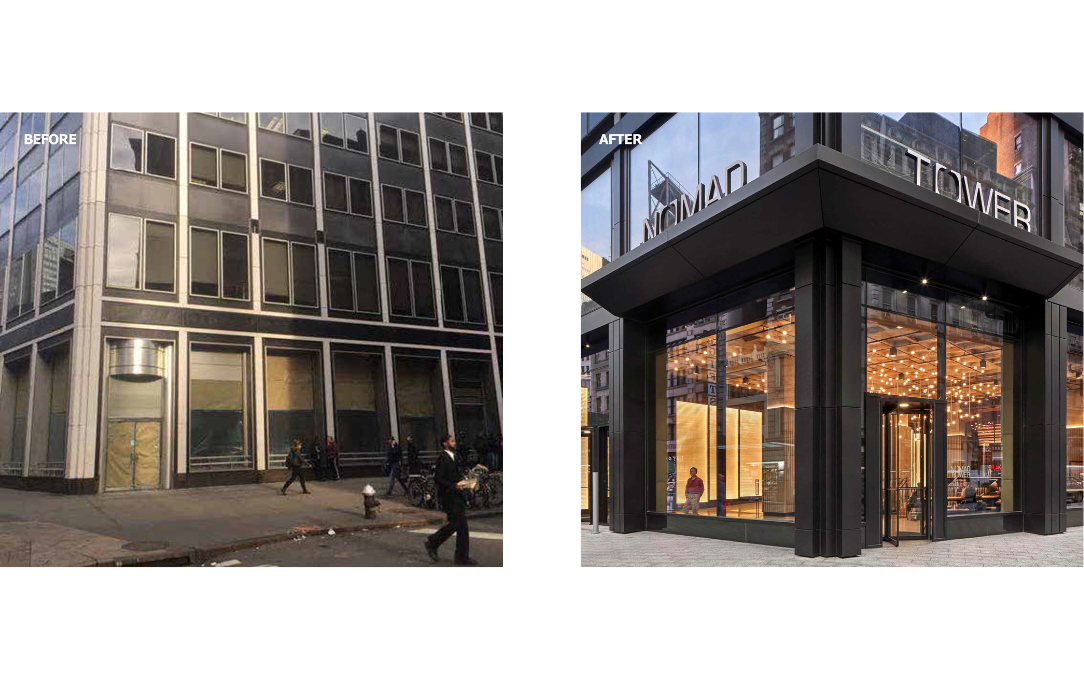
Beyond the physical reorientation, the repositioning required creating an experience that resonated with modern talent. Today’s workforce doesn’t return to the office for square footage; they return for relevance. To support this, designers focused on creating upscale amenities that act as a magnet rather than a mandate. We integrated private lounges, a conference center, a 90-person all-hands meeting amphitheater, a gym, a coffee bar, and New York’s largest bicycle storage. These additions give tenants the freedom to utilize high-value spaces without expanding their own footprints, fostering a community within the building and building connections among tenants.
Both the design and the curated amenities intentionally draw on the dichotomy of the NoMad neighborhood, marrying light and dark, old and new, casual and formal. This approach ensures the building feels alive, aligning the workspace with how younger talent actually lives and interacts with their city.
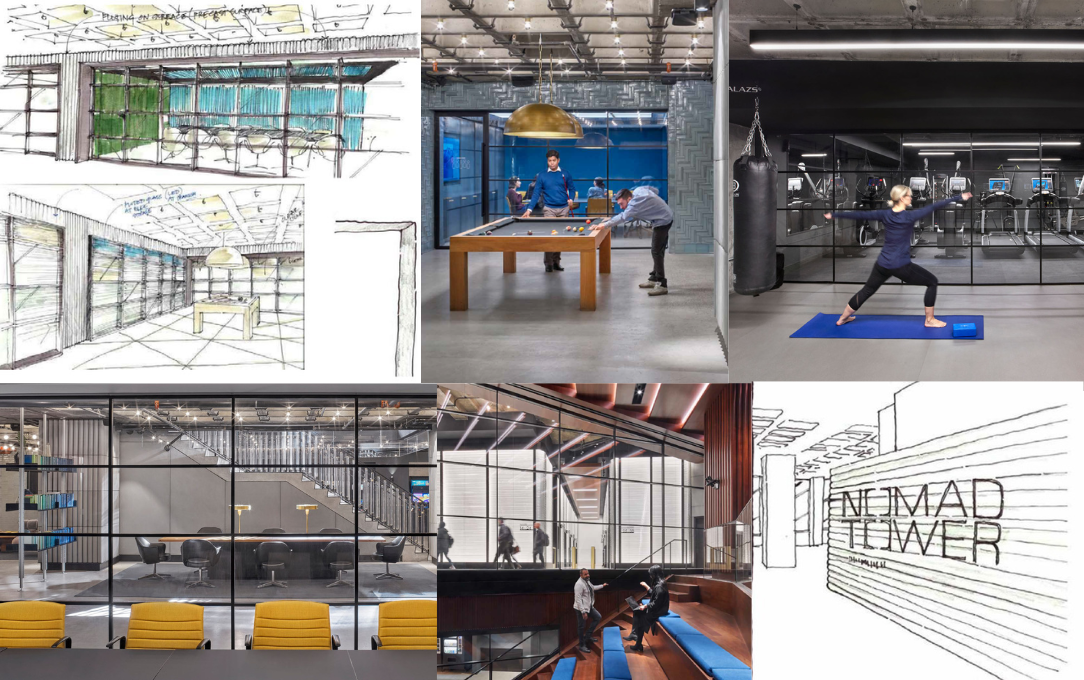
The successful re-brand of NoMad Tower demonstrates that space is no longer the answer; it is the expression of the answer. By treating the workplace and its surrounding mixed-use neighborhood as a cohesive experience ecosystem, we helped ownership unlock value that could never have been achieved through cosmetic updates alone.

Let's Connect:
David Filak, Associate Principal | Senior Studio Leader | Business Development Leader, Asset Strategy
David is a dynamic and motivated professional with a talent for generating and building relationships. His experience as a professional athlete has offered an inside look at what makes for a successful team. David leverages this experience by learning the goals and drivers of a project, designing educational and delivery strategies, and coaching individuals towards success. He is an adaptable leader with the ability to promote enthusiasm in the workplace and on project teams. David is an active member of the BOMA ELC: Emerging leaders program. Reach out to him at DFilak@nelsonww.com
