Why Cold Storage Demands More than Your Typical Industrial Playbook
By: Adam Bortz
Cold storage has evolved from a niche asset class into a core industrial product type, albeit, one of the most demanding and technically challenging to both design and execute. Driven by e-commerce, grocery distribution, and life sciences, demand for temperature-controlled facilities continues to grow.
For developers and investors, the opportunity is clear. But so is the risk.
At a recent ULI Philadelphia Industrial Product Council panel I hosted in Philadelphia, industry leaders made one thing unmistakably clear: cold storage is not just a copy/paste of the typical way we approach industrial development. The way the building functions and the role it plays in sustaining the way we live make it a fundamentally different product type—one that requires specialized expertise at every stage; from the early stages of capital procurement and site selection through construction and execution, and then ultimately the building’s operation, we can emphatically say that cold storage is in a league of its own.
For those looking to enter the space, the question isn’t whether demand exists. It’s whether you’re equipped to deliver the right product.
Demand is Strong, But Oversupply is Hindering New Construction
Cold storage fundamentals remain compelling. The sector is increasingly viewed as critical infrastructure, supporting food supply chains and pharmaceutical distribution. Long-term demand is not in question.
However, the panel highlighted a growing disconnect in the market. While vacancy has increased in certain regions, it’s not due to a lack of demand—it’s due to a mismatch between what’s being built, what’s existing today, and what users actually need.
To complicate matters further, a not-insignificant issue with the glut in that national cold storage supply, has a lot to do with the age of most of the inventory. Upwards of 75% of the buildings on the market are 40 years or older and are incredibly inefficient or do not comply with rapidly changing modern health and safety regulations. Repositing’s and renovations of those older facilities, while possible (and we’ve done a number of them), have the tendency to become cost prohibitive because of how surgically grafted their critical systems are into the bones of the building. We’re also seeing that a number of these buildings are larger than what modern tenants are looking for.
In other words, the issue isn’t just that the market is overbuilt—it’s potentially misbuilt, and frankly a little geriatric. Cold storage facilities are highly specific to their end users and have completely different requirements based on what’s being stored or produced within. A building designed for holding slower moving frozen food may not also work for distributing fresh produce or manufacturing GLP-1 drugs or therapeutics. A layout optimized for bulk storage may fail in a high-throughput distribution environment. Without a clear understanding of these nuances, even well-located, newly constructed facilities can struggle to lease.
As one panelist noted, there simply isn’t enough standardized data in this sector to rely on conventional development playbooks. Every project requires a tailored approach.
Location Still Matters—But It’s More Complex than You Think
Markets like Philadelphia illustrate how critical infrastructure and proximity to the pockets of population that the building supports drives success. With one of the highest concentrations of refrigerated port activity in the country (which ranks third in cold volume)—handling upwards of 60% temperature-controlled goods compared to 10–15% at most ports—the region has become a natural hub for cold storage development.
But proximity to ports or population centers is only part of the equation. Developers must also consider:
- Access to labor (and rising labor costs)
- Transportation networks and dwell times
- Utility capacity and long-term energy resilience
- Environmental and geotechnical constraints (especially in port-adjacent sites)
Getting location wrong isn’t just inconvenient—it can easily unravel the entire operational model and the proforma.
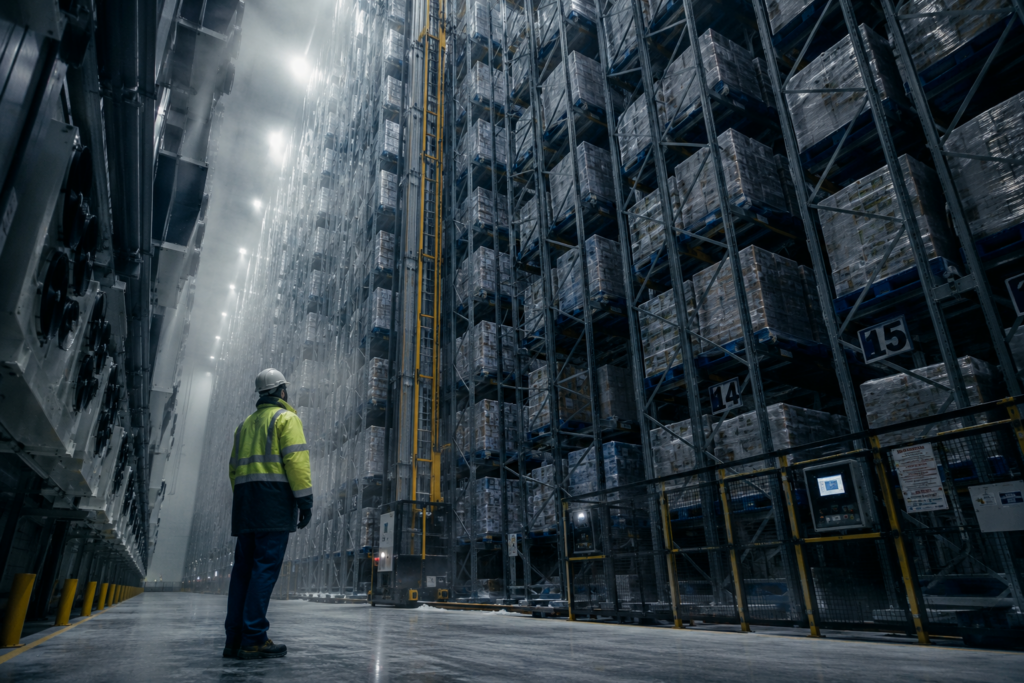
Design and Construction: Where Small Mistakes Become Big Problems
Cold storage buildings are unforgiving. Unlike traditional industrial facilities, where minor construction issues can be corrected over time, cold storage demands precision. Air and more critically moisture infiltration, for example, can lead to condensation, ice formation, and system inefficiencies that are costly—and sometimes financially crippling—to fix after the fact.
Even something as seemingly straightforward as the roof-to-wall interface requires complex tight coordination across trades and rigorous quality control in the field.
Layer onto that the need for specialized materials, advanced insulation systems, and highly engineered refrigeration infrastructure, and it becomes clear: this is not a product type where teams can afford to learn on the job.
Energy and Operations Are the Real Value Drivers
One of the biggest misconceptions about cold storage is that it’s a real estate play first. In reality, it’s an operational business wrapped in a building.
Energy costs alone can define a project’s long-term success. The panel shared examples of legacy facilities costing millions annually to operate, while modern buildings, designed with high-performance envelopes and efficient systems, can reduce those costs dramatically.
At the same time, rising labor costs are pushing operators toward automation. But here again, the message was clear: automation is not a one-size-fits-all solution. It must be aligned with the specific product mix, throughput, and operational goals of the facility—or it can become a costly misstep.
For developers and investors, the takeaway is clear: optimizing cold storage means thinking beyond construction and focusing on long-term operational performance, which requires implementing specific solutions for unique tenant needs in each industry sector of cold storage, for each building.
Why Experience Matters More than Ever
Across every topic—site selection, design, construction, and operations—the same theme emerged: cold storage requires early, integrated decision-making with a tight knit project team.
Unlike traditional industrial projects, where tenants can function in just about every building that’s available to them, cold storage demands the opposite. The building must be designed around the user, the product, the process, and ultimately, the population that building will serve.
From aligning development strategy with real market demand, to coordinating with operators, engineers, architects, and contractors, to ensuring that critical details are executed correctly in the field, the margin for error in cold storage is thin. The cost of getting it wrong is high, which makes the capital risk is massive. That’s why experienced partners are essential.
The Opportunity—and the Imperative
Cold storage offers compelling upside for developers and investors—but only for those who approach it with the right level of rigor and expertise.
As the industry continues to evolve, success will depend on making smarter decisions earlier in the process: choosing the right sites, designing the right product at the right size, and building to optimize long-term performance—not just short-term delivery.
For those entering the space, take the lessons learned from the panel’s seasoned vets: partner with teams who understand the complexity, have done it before, and can guide you through the nuances in the cold storage process safely.
Because in cold storage, experience isn’t just helpful. It can be the difference between a successful investment and a costly lesson.
To be clear, it’s the best way to putting your development on thin ice…

Let's Connect:
Adam Bortz, Director | Practice Strategy Leader
Bortz brings a wealth of experience to NELSON, having worked in the architecture and design industry in various capacities. A graduate of Thomas Jefferson University and a Controlled Environment Building Association (CEBA) Professional, Bortz honed his skills at Roberson Butz Architects before making notable contributions to flagship projects for Tommy Hilfiger, innovative store concepts at IKEA, and impactful developments for clients including Dick’s Sporting Goods and Chick-fil-A.
