The $10 Trillion Real Estate Gamble
By: John Capobianco
Workplace strategy has officially entered uncharted territory. Between rapid AI integration, fluctuating hybrid models, and headcount volatility, corporate leaders are regularly forced to make multi-million-dollar portfolio decisions with incomplete information.
In this environment, the greatest risk to an organization isn’t making a wrong spatial assumption—it’s making that wrong assumption at scale, institutionalizing it across an entire portfolio, and being locked into a costly, long-term commitment.
When organizations make the wrong workplace bet, the fallout goes far beyond real estate write-offs. It directly compounds global productivity losses—which topped $10 trillion in 2025 due to low employee engagement—and drives talent attrition.
With U.S. office vacancies projected to reach 21.5% by 2030, the office can no longer be viewed simply as a fixed physical asset. It must be treated as a strategic tool designed to spark collaboration, support wellbeing, and remain highly adaptable.
To build that adaptability, the world’s most sophisticated organizations are shifting away from guesswork. Instead, they are adopting a prototyping mindset: replacing assumptions with evidence before the financial stakes are highest.
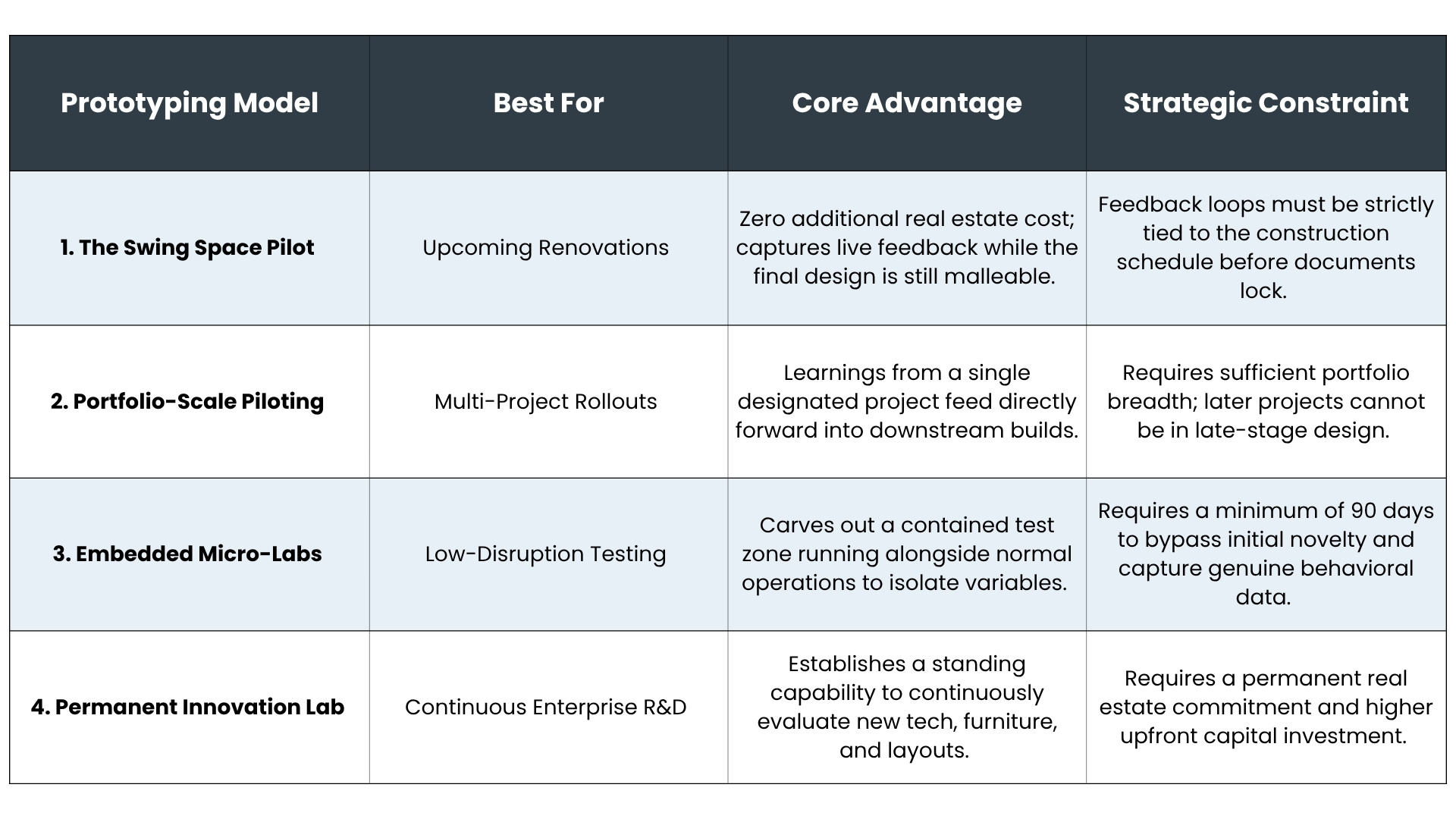
Moving from Assumption to Evidence: 4 Prototyping Models
94% of global companies now plan to run workplace prototypes or pilots. However, a pilot program is not a one-size-fits-all solution. The right model depends heavily on an organization’s portfolio position, time constraints, and appetite for operational disruption.
Data as Capital: Closing the Workplace Feedback Loop
A pilot program without data-driven action is simply an expensive observation. To transform spatial data into organizational capital, a prototype must be treated as a rigorous learning system built on three distinct pillars:
1. Define First: Stakeholders must agree on what successful outcomes look like—and the specific hypotheses being tested—before occupancy. Without a clear hypothesis, there is no learning, only observation.
2. Instrument the Space: The environment must be explicitly instrumented to gather clean data. Whether utilizing depth sensors, pulse surveys, or structured observation studies, the measurement must match the specific questions being asked.
3. Establish Decision Gates: Data is only valuable if it changes a future decision. Organizations must build formal review milestones where pilot findings directly dictate the next density metrics, technology standards, or floor-plate configurations.
The Live Test: Shifting to Day-Two Optimization
The workplace is no longer a static monument; it is an evolving product. True strategic resilience requires looking at the office with a mindset of continuous evaluation—extending the concept of the pilot into the post-build phase.
By treating a newly completed environment as a “live test” during its initial months of occupancy, organizations create an intentional pathway for modifications based on actual behavioral data. This ensures that spatial alignments are fine-tuned in real time, maximizing both real estate efficiency and workforce performance.
Turning Spatial Insight into Strategy
At NELSON Worldwide, we believe that navigating the future of work requires a deliberate balance of design innovation and data-backed evidence. Our Workplace experts provide the dedicated framework to help organizations design, instrument, and evaluate tailored workplace prototypes.

Let's Connect:
John Capobianco, National Design Leader, Workplace
A leader in workplace design, John is recognized for his commitment to using design as a catalyst for human experience, organizational performance, and sustainable impact. With over 25 years of experience, he has led transformative projects for some of the world’s most influential organizations and his work consistently blends strategic insight with design excellence, redefining how physical space can reinforce a company’s mission and drive culture, innovation, and productivity. John holds a Master of Professional Studies in Design Management from Pratt Institute and a Bachelor of Science in Interior Architecture from Wentworth Institute of Technology. He is co-chair of the IIDA NY Partnership Committee and a member of the CoreNet NY Awards Committee.
