Public Perception is Industrial’s Next Hurdle
By: Adam Bortz
Why public buy-in, civic fit, and architectural vision are becoming essential ingredients in securing industrial approvals today.
OUR NEXT HURDLE
For years, industrial commercial real estate went to battle against constraints we can measure: land, infrastructure, labor, and electrical capacity. Today, after years of sitting through planning commission hearings and city council meetings, another opponent is giving capacity a run for its money: adverse public perception.
Industrial real estate has a PR problem right now. NBC News reported that in the first three months of 2026 alone, communities blocked or delayed at least 75 major industrial-scale developments nationwide, marking the highest level of resistance on record. Thankfully, demand is rising again (industrial leasing activity is forecast to rise 5% year-over-year to nearly 1 billion SF, per CBRE). But as we ‘turn the tap back on,’ the industry can no longer assume yesterday’s playbook will secure project approvals. This new upcycle is driven by tenants prioritizing modern, resilient facilities, raising the bar for what gets built and where.
Anecdotally, what I’m seeing is that projects are being slowed, reshaped, or stopped by whether the community believes the project belongs in their backyard. And if you’re reading this, you’re likely seeing the same thing.
The New Constraint Is Public Perception
Communities aren’t inherently anti-development; they’re anti-bad development. When residents show up in opposition, they are reacting to a very real lived bundle of fears: truck traffic, noise, glaring lights, air quality, property value anxiety, and the suspicion that they must absorb the downside while an outsider monetizes the upside.
Some concerns are grounded in reality. A 2024 George Washington University study found U.S. communities near warehouses experience increased truck traffic and an average 20% bump in health-harming nitrogen dioxide.
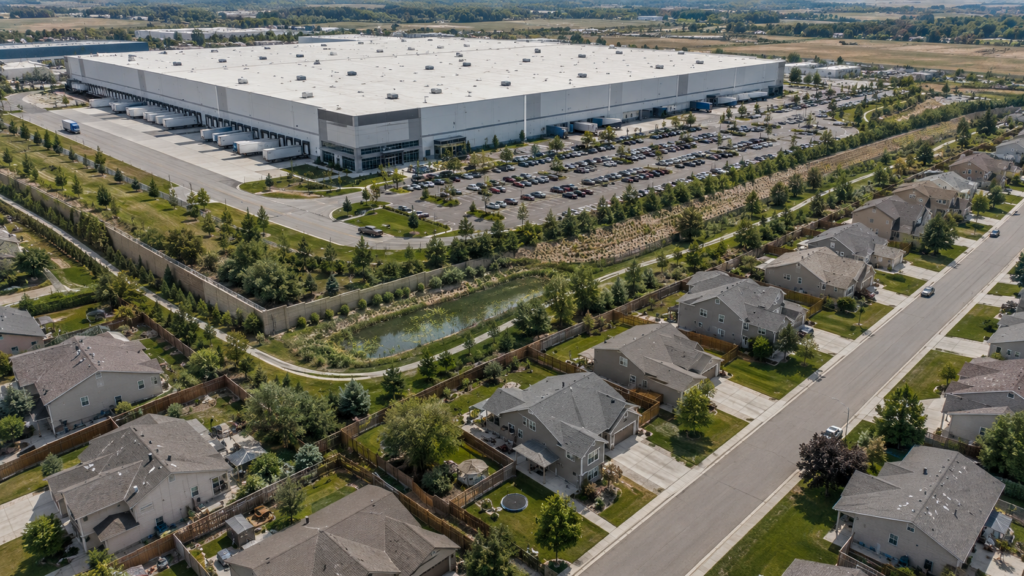
These buildings are essential to modern life, which is why our industry needs to ask an uncomfortable question: Are we helping create the backlash we now face head-on? If we come to a jurisdiction believing legal entitlement dictates public acceptance, we shouldn’t be surprised when residents show up with pitchforks. Legally permissible is not the same as politically durable, and in today’s entitlement climate, the gap between those two conditions is where projects stall at a staggering clip.
The Industry Has a Design Reputation Problem
Industrial development has long been designed as an internal machine, optimized for operations, ROIs, KPIs, and truck turning radii. But through the community’s lens, what arrives is often a giant box, a line of loading docks, and an ugly berm backed by our stance that jobs and tax revenue should settle the matter.
That approach is wearing thin. The irony is that the communities most averse to industrial projects are often the most reliant on the e-commerce and supply chains they deliver. But locally “essential” cannot become an excuse for contextually “indifferent.” The projects navigating opposition successfully are those that make a meaningful extension into the community and integrate public concerns into the design process early—not as theater, and not as a box-checking exercise.
From Utility to Civic Contribution
To move forward, the industry must evolve its approach across five key pillars:
Performance
Operations, yard efficiency, and power still matter—this isn’t an argument for sacrificing logistics for lipstick. But if those drivers are approached strictly as a civil engineering math problem, they become fuel for opposition. Designing with the public in mind means separating truck and local traffic, managing onsite queuing so trucks don’t spill into commuter routes, and mitigating headlight glare and backup alarms at the neighborhood edge. Good planning reduces conflict before the hearing.
Perception
Architecture must do heavier lifting. The public understands scale instinctively; they recognize a blank wall, glare, and what it feels like when a building crashes down into a context where it doesn’t belong. We must design with thoughtful massing, pleasant façade rhythm, material variation, smarter site orientation, and edge landscaping to make these buildings look like they belong—not like they crash-landed from an Excel spreadsheet. An industrial building won’t be a museum, but neither can it remain an anonymous extrusion with the civic charm of a QR code.
Placemaking
Historically, the edge of an industrial project was treated as something to hide or buffer. Instead, the edge should be treated as a place to contribute, whether through public walking paths, green edges, habitat restoration, or community-facing landscapes. Large-format sites and underutilized setbacks should be reimagined as civic infrastructure rather than dead residual space. If a building is large enough to impact the landscape, it should be on the hook to do so responsibly.
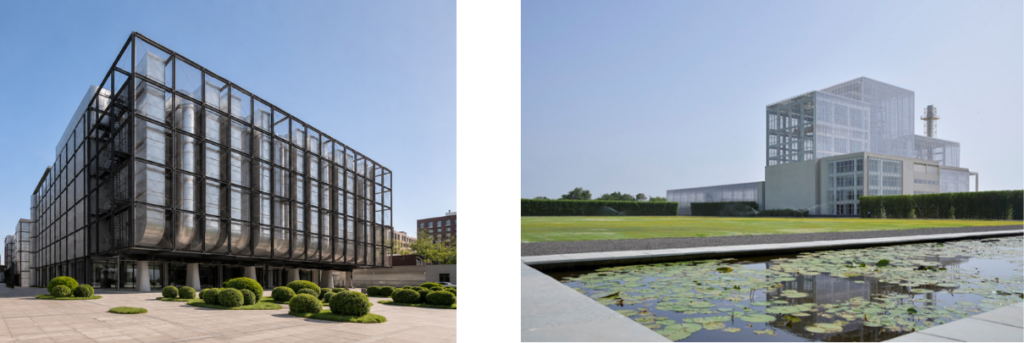
L: Spark 761, Beijing, CN (Image Cred. LLLAB) R: Waste-To-Energy Campus, Jamnagar, IN (Image Cred. INI Design Studio)
Participation
Public engagement should not begin once the site plan is finished and a polished PowerPoint is presented at a hearing. At that point, the public doesn’t feel valued; they feel managed. Guidance from the EPA and APA emphasizes that early, meaningful engagement increases trust and project acceptance. When local concerns are dismissed, resistance hardens. The fastest way to make a public meeting combustible is to treat it as the first time the public deserves to know what’s coming.
Prosperity
Who has time for this, and who is going to pay for it? Fair question, but it assumes the traditional approach is still working. The cheapest version of a project on paper is rarely the cheapest in reality. Projects stalled in hearings, facing political headwinds, or absorbing months of delay pay a massive premium that never shows up in the initial pro forma. Seen this way, design is critical risk management and long-term value creation.
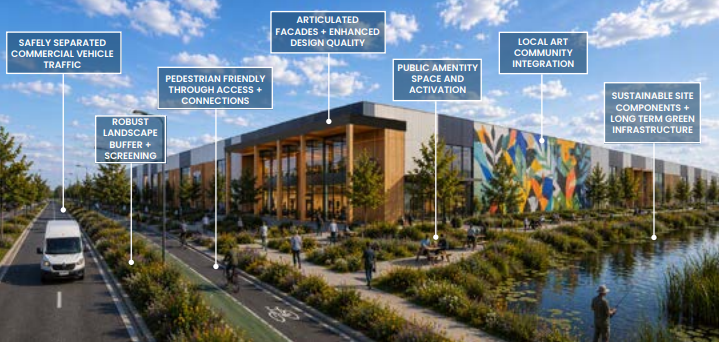
A More Successful Industrial Future Starts With Better Design
Let’s be honest: a 40-foot-clear warehouse is unlikely to be mistaken for a beloved local landmark anytime soon. But that does not mean these projects have to be a visual or physical burden on the communities they anchor.
Industrial real estate supports how we live every day: our food, our medicine, our commerce, our resilience, and our manufacturing capability. The issue is not whether industrial development is necessary. It is whether our industry is willing to evolve its approach to how that necessity integrates into the built environment.
If public perception is rising as our next major constraint, architecture is one of the most powerful tools in our arsenal. That means designing buildings as neighbors, not just assets. It means engaging communities before the room is enflamed and making public benefits spatial rather than rhetorical. The demand is there, but the social license to build can no longer be assumed. We have a future-facing opportunity to prove that industrial development can do more than perform efficiently—it can belong.
Let's Connect:
Adam Bortz, Director | Practice Strategy Leader
Bortz brings a wealth of experience to NELSON, having worked in the architecture and design industry in various capacities. A graduate of Thomas Jefferson University and a Controlled Environment Building Association (CEBA) Professional, Bortz honed his skills at Roberson Butz Architects before making notable contributions to flagship projects for Tommy Hilfiger, innovative store concepts at IKEA, and impactful developments for clients including Dick’s Sporting Goods and Chick-fil-A.
